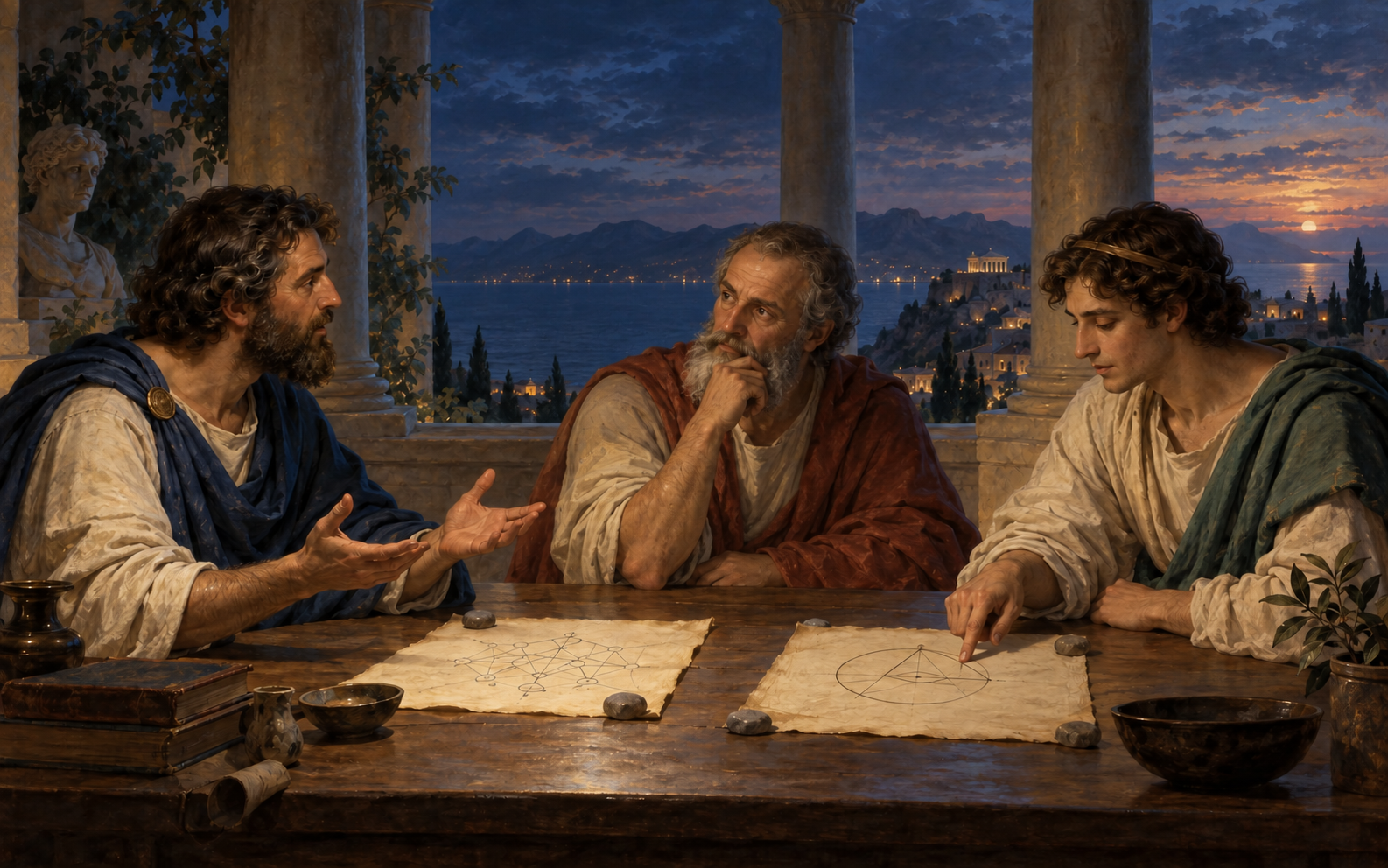
An AI-generated philosophical dialogue. This dialogue was generated by ChatGPT 6 Pro from my prompt, using the literary and argumentative style of Plato’s Dialogues, especially The Republic, together with Galileo’s Dialogue Concerning the Two Chief World Systems.
It draws on “A Severe Misalignment of AI in Mathematics”, initially signed by 25 Fields Medalists, and Timothy Gowers’s “Why I didn’t sign the Fields medallists’ letter”. The dialogue below is reproduced from the shared ChatGPT conversation, with its wording and source notes preserved under the title chosen for this post. The full prompt appears at the end.
A dialogue in three evenings
This fictional dialogue takes its point of departure from “A Severe Misalignment of AI in Mathematics,” published on September 11, 2026, with 25 initial Fields Medalist signatories, and Timothy Gowers’s response of September 17. Philon defends the declaration’s concerns; Theon begins from Gowers’s objections; Lysias examines both. Neither principal speaker represents every belief of the people whose arguments inform him. The italicized source notes distinguish the texts’ positions from the original philosophical arguments developed here. All speeches, thought experiments, and concessions are invented. What's new
First Evening
What is increased when mathematics advances?
The declaration subordinates problem-solving to conceptual understanding. Gowers defends plural mathematical purposes and questions that hierarchy. Math and AI
When I arrived at the school, Philon had already placed the two papers on the table. He had weighted their corners with small stones, although there was scarcely any wind.
Theon noticed this and smiled.
“You are afraid that the arguments will escape?”
“Only that they will be separated before they have been read together.”
Lysias, who had come without any papers, drew up a chair.
“Then let us begin by resisting the invitation their arrangement offers us. There are two documents, but it does not follow that there are two armies.”
“No,” said Theon. “Nor that the man who declines to enter one army wishes victory to another.”
Philon inclined his head.
“Let us ask instead what we are defending.”
“Mathematics,” said Theon.
“That answer,” Lysias replied, “has the admirable property of postponing every difficulty. Tell me what it includes.”
Philon rested his hand on the nearer paper.
“Suppose that tomorrow we receive a demonstration of some great conjecture. Suppose further that the demonstration is correct. We have gained something. But now imagine that no one can explain its organizing idea, distinguish its essential steps from its accidents, or see which other questions it illuminates. Would you say that everything worth gaining has already been gained?”
“Certainly not.”
“Then the acquisition of a proof and the acquisition of understanding are not identical.”
“Agreed. But neither does it follow that the first is valuable only insofar as it produces the second.”
“Explain.”
“Imagine that the theorem determines whether a certain construction is possible. Its proof is difficult, but its conclusion can be used with confidence. People build something valuable because a question has been settled. Must they wait for our seminar to declare the result intellectually mature before their benefit becomes real?”
“No,” Philon said. “But you have moved from the good of mathematics to the good of its application.”
“And you have spoken as though those goods were yours to separate and rank.”
Lysias looked from one to the other.
“Already we have found an ambiguity. When you ask what mathematics is for, are you asking what a mathematician should desire, what a mathematical institution should cultivate, or what society should support? Those need not have one answer.”
Philon considered this.
“A person may enter a school seeking distinction and nevertheless contribute to an enterprise whose justification is not the distribution of distinctions.”
“True,” said Theon. “But an institution may also be sustained by several legitimate purposes. You cannot infer from their coexistence that one is the true purpose and the others merely serve it.”
“Would you then have no ordering of goods?”
“I would first ask whether an ordering is needed. A person who wants to settle a question may develop a theory. Another who wants to understand a structure may settle a question. Their cooperation need not depend on either admitting that his deepest satisfaction is a misunderstanding of his own work.”
“But there is a public question,” Philon answered. “Suppose resources are limited. Suppose we must choose between producing further results and teaching the results we possess. We cannot indefinitely praise both and decline to choose.”
“Certainly. Yet a choice under particular circumstances is not a definition of the final purpose of mathematics.”
Lysias drew two circles on the scrap of paper before him.
“Then perhaps your disagreement begins here. Philon fears that unless one good is explicitly protected, another will swallow it. Theon fears that the protection will be purchased by declaring other mathematical lives inferior.”
“That is close,” said Philon.
“And close enough to be worth disputing,” said Theon.
“Let us make the dispute harder. Imagine two cities. In the first, many difficult questions are answered, but few citizens understand the answers. In the second, fewer questions are answered, but a larger part of the population participates intelligently in the subject. Which city possesses more mathematics?”
“The question conceals a measure we have not agreed upon,” Theon said.
“Precisely.”
“Then why ask it?”
“Because people who have not agreed upon a measure often speak with great assurance about increase and decline.”
Philon smiled reluctantly.
“Would you have us abandon those words?”
“No. I would have you tell us what must be counted before using them.”
Whose purpose has been missed?
The declaration criticizes benchmark incentives, hurried exposition, attribution failures, and disrupted human transmission, while recognizing AI’s potential. Gowers expects expository deficiencies to be temporary. Math and AI
A servant brought a lamp. Philon moved the papers farther from its flame.
“Consider two machines,” he said. “They are equally capable of discovering proofs. One is accompanied by explanations, records of dependence on earlier work, and opportunities for students to question its arguments. The other delivers discoveries in a form that continually demands attention without helping those who must understand them. Would you regard their contributions as equal?”
“No,” said Theon.
“Then the manner in which mathematical power is directed matters independently of the power itself.”
“Yes. But now say exactly what you mean by misalignment. Has the second machine failed at its assigned task? Has its maker chosen a bad task? Or has its maker pursued a legitimate purpose while neglecting the effects on other people? Those are different accusations.”
“They may require different remedies,” Philon conceded.
“More than that. A machine can faithfully serve a purpose that you dislike. A company can satisfy its customers while leaving important public needs unmet. And a community can describe a conflict of interests as though everyone had already agreed about the correct destination.”
Lysias leaned toward Philon.
“With whose purposes must the machine be aligned?”
“With the purposes that make its use worthwhile.”
“To whom?”
“To human beings.”
“All human beings in the same way?”
Philon paused.
“No.”
“Then the word does not spare us political argument.”
“I never intended it to.”
“But it may appear to. A misaligned instrument sounds like a compass pointing away from a north that everyone recognizes. Your north may be precisely what is disputed.”
Theon nodded.
“That is my concern. Let us not give a disagreement about ends the appearance of a simple engineering defect.”
Philon answered at greater length.
“Then I will put the matter without the instrument. Imagine several capable institutions competing for recognition. Each can choose to devote its next effort to a conspicuous discovery or to the less conspicuous work that makes previous discoveries usable. Suppose each expects the others to pursue the conspicuous prize. Even people who sincerely value explanation may then neglect it. No villain is required. The difficulty lies in an arrangement under which everyone has a reason to postpone what everyone says should eventually be done.
“My concern does not depend on proving that a machine cannot explain. It would survive the arrival of an excellent mechanical teacher. We would still have to ask whether teaching was being provided, to whom, and under what conditions.”
“That is a stronger argument,” said Theon. “It does not rely on permanent machine incapacity.”
“Would evidence of excellent machine teaching change your mind?” Lysias asked Philon.
“About some things, greatly. I would withdraw any objection that depended upon explanation being unavailable. I would not withdraw a question about whether people had the time, support, and reason to learn.”
“Then you must permit the answers to separate. You might find the technology helpful and the surrounding arrangements destructive.”
“Yes.”
“And you,” Lysias said to Theon, “must permit the reverse of another common inference. Showing that a defect could be repaired does not show that it will be repaired.”
“I permit it.”
“Good. We have removed one false quarrel. We need not decide whether machines are inherently friends or enemies of understanding. We must ask which arrangements make their capacities serve which goods.”
Philon looked at the two papers.
“That sounds less dramatic than a warning.”
“It may also tell someone what to change.”
Second Evening
The proof that no one reads
Gowers argues that an unread surplus need not prevent increased collective understanding, and envisages AI-supported active learning. Gowers's Weblog
On the second evening, Theon arrived carrying a bound volume. He placed it between the two papers.
“I have brought an embarrassment,” he said. “A book I have owned for years and never understood.”
“Why bring only one?” asked Lysias.
“Because I wished to preserve some dignity.”
Philon opened it at random.
“What is your argument?”
“Only that our ignorance requires a comparison. The existence of unread mathematics does not by itself establish a loss.”
“No,” Philon answered. “But we should distinguish a book waiting for a reader from a system that makes readers less likely to exist.”
“Then show the connection.”
“I cannot establish it by pointing to the book. That much I grant.”
Lysias took the volume and closed it.
“Let us imagine an experiment, rather than allow our metaphors to produce their own evidence. A school divides its students between two forms of instruction. Both groups have access to the same discoveries. One receives completed arguments immediately. The other receives questions and graduated assistance, with opportunities to struggle before seeing the solution. What should we examine afterward?”
“Whether they understand the material,” Philon said.
“How would you tell?”
“Whether they can explain why assumptions matter, adapt an argument when a hypothesis changes, identify a misleading analogy, and formulate a useful question that was not put to them.”
Theon raised a hand.
“Those seem reasonable tests. But now imagine that the first group performs better.”
“I would have learned something.”
“Would you accept the result?”
“Provided the comparison was sound.”
“And if it persisted?”
“I would revise my belief about the necessity of the particular struggle we had removed.”
Lysias turned to Theon.
“Now imagine that the second group performs much better, including on tasks for which both groups may consult the same machine.”
“Then I would accept that the form of instruction matters, and that supplying an answer too early can impede the development of some capacities.”
“Would that establish a general case against autonomous discovery?”
“No. It would establish a case for changing instruction.”
Philon nodded.
“And here is where my concern becomes more difficult. A school may know how to teach well and still fail to do so. The availability of a good method does not guarantee its adoption. Nor does a successful course establish that a whole profession can reproduce itself under changed expectations.”
“True,” Theon said. “But you must not allow every favorable result to be answered by moving the danger farther away.”
“I must not. Equally, you must not treat a demonstration of possibility as evidence that the favorable outcome will arrive without effort.”
Lysias seemed pleased.
“Now each of you has asked the other to distinguish possibility from probability. Can either offer a probability?”
“Not an honest numerical one,” Philon said.
“Nor I,” said Theon.
“Then let us identify what remains uncertain without dressing the uncertainty as a calculation.”
Theon spoke first.
“We do not yet know which human capacities can be developed more effectively with these tools, which require deliberately withholding assistance, or how much the answer varies among learners and kinds of mathematics.”
“And,” Philon added, “we do not know how changes in recognition and employment will alter the number of people who undertake that development at all.”
“Those are proposed questions,” Lysias said, “not findings.”
“Agreed.”
“Then what makes the matter urgent?”
Philon answered quietly.
“The possibility that the time needed to discover the damage exceeds the time needed to make it difficult to reverse.”
“A reason to investigate,” said Theon.
“And perhaps to protect some things while investigating.”
“Perhaps. But which things, at what cost, and against which danger? Urgency cannot answer those questions merely by repeating its own name.”
For a while neither spoke.
Then Lysias reopened the book.
“There is one further difficulty. Your experiment must be judged by an account of what an educated mathematician should be able to do. The evidence will not choose that account for you.”
“Then we are back at the first evening,” Philon said.
“Not quite. We now know which part of the disagreement an experiment might settle, and which part would survive its success.”
What becomes of the apprentice?
Gowers fears weakened recruitment and funding. Attribution matters now, he argues, but the prevailing credit system may soon disappear. Gowers's Weblog
A student crossed the courtyard carrying a slate. Philon watched until the door had closed behind her.
“Let us suppose that our schools remain open,” he said. “That does not tell us what we shall invite her to become.”
“Do not answer too quickly that she must become what we became,” Theon replied.
“I agree. But do not answer too quickly that any replacement will serve.”
Lysias asked what each would offer her.
“A life of learning to judge difficult things,” Philon said. “Of making ideas accessible, finding connections, and helping others acquire powers they did not possess.”
“A worthy life,” said Theon. “But an invitation is not fulfilled by naming worthy activities. Will she have independence? Will she be able to choose questions? Will the institution respect her judgment, or merely ask her to polish what a machine delivers?”
“You fear the degradation of interpretation into service.”
“I fear that we may praise a new vocation while organizing it as subordinate labor.”
Philon considered him for a moment.
“Then you are not defending only the pleasure of being first.”
“No. Although I will not pretend that pleasure is contemptible.”
“Should the city pay to preserve it?”
“Not merely because established scholars enjoy it. But motives are part of an institution’s construction. You cannot remove a powerful motive and replace it with a speech about how noble the remaining duties are.”
Lysias interrupted.
“Suppose the new arrangements offer genuine independence, good support, and esteem for excellent explanation. Suppose students find them attractive. Would either of you object because the life differs from your own?”
“I would not,” said Philon.
“I hope I would not,” said Theon. “I prefer that answer because it leaves room for discovering an attachment I had mistaken for a principle.”
“Then let us make the transition less comfortable.”
Lysias put the student’s imagined future aside and described a young scholar who had developed a difficult method. A machine then used that method to obtain a celebrated conclusion. The conclusion attracted attention; the method and its author did not.
“What is owed?” he asked.
“Recognition of the dependence,” Philon said.
“For the scholar’s career?”
“For that reason, but not only that reason.”
Theon drew the scrap of paper toward him.
“We should separate three accounts that are often entered in one ledger. One concerns where ideas came from. Another concerns who should receive rewards. A third concerns who accepts responsibility for the claims being circulated. Those accounts may change differently.”
“Explain the consequence,” Lysias said.
“A future institution might distribute prestige differently without making the history of an argument irrelevant. It might reduce the importance of personal ownership while increasing the need to identify who checked a claim. We should not let a prediction about one account erase obligations in the others.”
Philon nodded.
“And whatever system we hope to have later, the apprentice is living under the present one. It would be a curious justice to announce that recognition is about to become obsolete precisely when someone less secure than ourselves requires it.”
“Agreed.”
“Then may I put a question to you, Theon? How long can a supposed transitional injury continue before calling it transitional ceases to excuse our inattention?”
“It never excused inattention. At most, it could affect the remedy. We should not build a permanent institution around a difficulty likely to vanish, but neither should we leave people unprotected while predicting its disappearance.”
Lysias looked toward the door through which the student had gone.
“You are beginning to describe adaptation as an obligation with beneficiaries, rather than as a word addressed to whoever has least power.”
“And resistance,” Theon answered, “must likewise name its beneficiaries. Otherwise we may protect the dignity of our own past while making the student’s future smaller.”
Third Evening
A danger to whom?
The declaration extends its concerns beyond mathematics. Gowers separately mentions catastrophic societal disruption, including mass death, without analyzing that risk in this post. Math and AI
On the third evening, rain kept us indoors.
Lysias placed a fresh sheet between the others.
“Before we discuss a public warning, we should decide what danger it warns against.”
“The injury to an intellectual tradition,” Philon said.
“The injury to the people who sustain it,” added Theon.
“And injury beyond the school?”
“Certainly possible.”
“Possible in the same sense, supported by the same evidence, and requiring the same response?”
“Certainly not,” Theon replied.
“Then let us not allow the gravity of one danger to lend borrowed certainty to another.”
Philon asked him to continue.
“Imagine a city in which these machines improve material life greatly. Its citizens are secure, its institutions remain accountable, and many kinds of education flourish. Yet the particular culture of mathematical discovery we have known disappears. Would that be a disaster?”
“For that culture, yes,” said Philon.
“For humanity?”
“That would require a larger judgment.”
“Now imagine another city in which mathematical research flourishes while the same technology is used elsewhere in ways that make ordinary life intolerable. Has mathematics’ prosperity answered the question of whether the technology is beneficial?”
“No.”
“Then professional benefit and human benefit cannot simply stand in for one another.”
Theon folded his hands.
“Nor can mathematical capability certify safety. A system’s success in a domain we understand does not settle questions about its use, control, or consequences in domains we have not examined.”
Philon agreed.
“But neither should concern for our own tradition be dismissed merely because it is our tradition. People often first recognize a general problem where they have enough knowledge to see it closely.”
“Of course,” Lysias said. “The difficulty comes when familiarity with one part of the problem is presented as authority over all of it.”
“Would you have mathematicians speak only about theorems?”
“No. I would have them speak as mathematicians where their expertise bears on the claim, and as citizens where they offer judgments that require other forms of knowledge. The same person may do both. The danger lies in concealing the change.”
Theon looked at the paper.
“A medal may provide a reason to listen. It cannot supply a missing premise.”
“Yet it creates a responsibility,” Philon answered. “Those who will be heard may be obliged to say what less prominent people have been unable to make audible.”
“Yes,” said Lysias. “But the responsibility includes identifying the limits of what they know. Public influence increases the consequences of imprecision.”
Philon was silent for a moment.
“Then a warning should distinguish an observed injury, a plausible mechanism of further injury, and a feared outcome that has not been established.”
“And an opportunity should be described with the same discipline,” Theon said. “A beneficial use that can be imagined is not a benefit already secured.”
Lysias smiled.
“Now neither hope nor fear has been permitted to call itself evidence merely because it concerns something important.”
What warrants a warning?
The declaration demands urgent engagement, not a specified moratorium. Gowers doubts criticism of corporate production will help once powerful models become public. Math and AI
The rain grew heavier.
“Suppose,” Philon said, “that a community sees a credible threat to something difficult to rebuild. Must it wait until the threat is demonstrated before speaking?”
“No,” said Theon.
“Then uncertainty cannot by itself disqualify a warning.”
“No more than uncertainty can by itself justify one.”
“What additional condition would you require?”
“First, that the warning identify what it asks people to do.”
Philon leaned back.
“Sometimes the first purpose of a declaration is to make a neglected question public.”
“That is an action. Let us call it one, rather than imply that a more definite remedy has already been established.”
Lysias raised a finger.
“There may be several thresholds here. The evidence sufficient to justify discussion need not justify a costly restriction. The evidence sufficient to fund an investigation need not justify announcing that a particular outcome is inevitable.”
“Agreed,” said Philon.
“And a warning can be strong in one respect and qualified in another. It can say that the stakes are great without pretending that their probabilities are known.”
“Provided,” said Theon, “that its readers are not invited to mistake the first claim for the second.”
Philon answered with unusual force.
“But public caution has its own asymmetry. Those who change an institution need not always demonstrate that their changes are harmless before making them. Those who ask for protection may then be told that the injury has not yet been proved. By the time the evidence becomes conclusive, the institution may have lost the people needed to repair it. Is that a neutral standard?”
“No,” said Theon. “But neither is every preservation harmless. A restriction can deny benefits, entrench authority, or place the cost of maintaining an old arrangement on people who had little share in its advantages. We must compare uncertain futures, not set an uncertain change against an imaginary present that continues without cost.”
Lysias waited until both had finished.
“What would count as sufficient evidence for collective action?”
“For a modest and revisable protection,” Philon said, “a credible mechanism of serious harm, some reason to think it is operating, and a remedy whose burdens are proportionate.”
“And for a severe restriction?”
“More evidence, a stronger account of its effectiveness, and a clearer explanation of why less burdensome measures would fail.”
Theon nodded.
“I would add an obligation to say what evidence would lead us to withdraw the measure.”
“And would you place the same obligation on an institution pursuing rapid deployment?” Philon asked.
“Yes. It should be able to say which outcomes would count against its present course.”
“Then perhaps we are closer than the signatures suggest.”
“Perhaps. But we have not answered whether this particular form of collective speech changes the decisions that matter.”
Philon moved the lamp slightly.
“Let me offer a defense that belongs to this conversation, not necessarily to every signer. A declaration need not control discovery directly to influence its consequences. It might alter what universities reward, what journals require, what companies support, or what students can reasonably demand. Even where the production of results cannot be restrained, the allocation of responsibility may remain open.”
“That is possible,” said Theon. “What would show that the declaration was accomplishing it?”
“Changes in those practices.”
“And what would show that it was instead deepening hostility while leaving practices untouched?”
“The persistence of the practices, accompanied by that hostility.”
“Then you admit that a warning should be judged partly by its effects.”
“Certainly. But silence also has effects.”
Lysias laughed softly.
“You are both correct, and neither has yet been relieved of the need to investigate.”
Theon looked out at the rain.
“I will grant another point. Predicting that a development will occur is not the same as proving that every feature of its arrival is beyond influence.”
“And I,” Philon said, “will grant that calling for action is not enough. The action must reach the mechanism of harm rather than merely give our uneasiness a public form.”
The signature
The declaration emphasizes consequential human choices. Gowers questions its additional practical demands and rejects an opposing-camps interpretation of his refusal. Math and AI
Lysias drew the two papers together.
“Let us return to the missing signature. What does it mean?”
“That someone would not endorse the document,” said Theon.
“That answer seems disappointingly small.”
“It is small because the larger answers do not follow without further inquiry.”
Philon nodded.
“One may accept a danger and reject its description.”
“Or accept a description and doubt the remedy,” Theon continued.
“Or favor collective action while refusing a particular collective statement.”
“Or believe that the statement gives a contested value judgment the appearance of a settled conclusion.”
Lysias looked at Philon.
“And what might the signer reasonably fear in these distinctions?”
“That every effort to act together can be dissolved into qualifications. A declaration cannot contain a complete philosophy. People who agree about an urgent practical need may have to speak before they agree about everything.”
Theon answered slowly.
“Yes. But there is a difference between leaving a philosophical question open and settling it in a sentence so that the rest of the declaration may proceed. A person may decline the latter without demanding the former be answered before any action occurs.”
“Then neither a signature nor its absence is an adequate account of a person’s judgment,” Lysias said.
“No.”
“And yet each has public consequences.”
“Yes.”
“Then the obligation is not merely to sign honestly or refuse honestly, but to explain enough that others do not have to invent the missing argument.”
Philon took up the fresh sheet.
“What remains between us?”
Theon thought for a while.
“Whether human participation is one benefit among the benefits mathematical progress can produce, or partly constitutive of the progress we should care about.”
“Whether,” Philon added, “the capacities and motives that sustain such participation can be preserved under very different arrangements, or whether some of them depend more deeply on practices we may be about to lose.”
“And,” said Lysias, “how much influence remains over those arrangements, and which forms of public action are likely to use it well.”
Philon began to write, then stopped.
“You have left out the question of how long we may wait.”
“Only because it belongs to each of the others. Waiting is costly if the endangered good is difficult to restore, if the mechanism is already operating, and if an effective intervention is available. Speaking too strongly is costly if it misdescribes the danger, obstructs a benefit, or spends authority without improving the choices.”
Theon looked at the unwritten sheet.
“Then there is no single observation that will settle all of this.”
“No,” Lysias said. “Some evidence would alter our forecasts. Some experience would alter our confidence in a remedy. But no measurement can relieve us of saying which goods we are prepared to sacrifice, or who should bear the sacrifice.”
Philon set down the pen.
“And disagreement about those things need not make us enemies.”
“It need not,” said Theon. “Though saying so will not make the disagreement painless.”
By then the rain had stopped. From another room came the sound of a chair being moved and a student asking someone to explain a step again.
None of us spoke for a moment.
Then Philon opened the volume Theon had brought.
“What does this argument make visible?”
Theon drew his chair nearer.
“Let us first see exactly what it proves.”
Lysias listened to the voices in the adjoining room.
“And afterward,” he said, “let us ask what we would have to preserve so that someone will still wish to join us.”
The original prompt
Using the literary and argumentative style of Plato’s Dialogues, especially The Republic, together with Galileo’s Dialogue Concerning the Two Chief World Systems, write a sustained philosophical dialogue about the disagreement between the 25 Fields Medalists who signed the declaration “A Severe Misalignment of AI in Mathematics” and Timothy Gowers, who explained his reasons for not signing it in his post:Why I didn’t sign the Fields medallists’ letter.
Base the dialogue closely on the actual arguments, concerns, assumptions, and points of disagreement expressed in the declaration and in Gowers’s response.
Do not merely summarize the two texts. Reconstruct their disagreement as a genuine philosophical dialogue in which both sides question one another, defend their assumptions, identify weaknesses in the opposing position, and refine their own claims.
The dialogue should have the following features:
- Represent both positions accurately and charitably. Do not turn either side into a caricature or straw man.
- Let one principal character represent the concerns expressed by the 25 Fields Medalists, while another represents Gowers’s position. You may introduce a third Socratic-style interlocutor who asks clarifying questions and forces both sides to make their assumptions explicit.
- Focus on the deepest issues underlying the disagreement, including:
- whether rapid progress in AI mathematics should primarily be understood as an opportunity or as a serious risk;
- what “misalignment” means in the context of mathematical research;
- whether mathematicians should collectively issue warnings about AI development;
- the distinction between risks to mathematics as a profession and broader risks to humanity;
- whether current evidence is sufficient to justify strong public warnings;
- the epistemic responsibilities of leading mathematicians when discussing uncertain technological risks;
- whether refusing to sign such a declaration reflects disagreement with its conclusions, its wording, its evidentiary standard, or its proposed response;
- how mathematical research culture may change if AI systems become capable of producing major results autonomously.
- Use the Socratic method extensively. Characters should repeatedly ask questions such as:
- What exactly do you mean by this claim?
- What evidence would change your mind?
- Does your conclusion actually follow from your premises?
- Are you distinguishing possibility from probability?
- Are you distinguishing concern from evidence?
- What would count as sufficient evidence for collective action?
- Follow Galileo’s model by allowing each side to develop substantial arguments rather than giving short alternating remarks. The dialogue should contain extended reasoning, counterexamples, thought experiments, and attempts to identify where the disagreement ultimately comes from.
- Clearly distinguish claims that appear in the original texts from new philosophical arguments introduced to explore their implications. Do not attribute invented arguments or statements directly to Gowers or to any individual Fields Medalist.
- The goal should not be to declare a winner. Instead, identify the precise points at which the two positions genuinely diverge, including differences in empirical beliefs, definitions, standards of evidence, attitudes toward uncertainty, and views about the responsibilities of mathematicians.
Write the dialogue as serious intellectual literature rather than as a modern interview or debate transcript. Give the speakers distinct philosophical personalities, and allow the conversation to become progressively deeper as their initial disagreement is reduced to a smaller number of fundamental questions.